(2008 Archives)
December 30, 2008
We have posted a new update to our comet update page in our "Countdown to 500 Comets" program. This update reflects the fact that Comet 29P/Schwassmann-Wachmann 1 has undergone yet another outburst within the past couple of days.
A fairly bright supernova was discovered in the galaxy M61 by Japanese amateur astronomer Koichi Itagaki (one of the co-discoverers of Comet 205P/Giacobini P/2008 R6) on December 26. As of this morning the supernova appeared near magnitude 14 1/2.
December 27, 2008
The "In Our Skies" e-book available through our Earthrise Store now has columns up through the end of the fourth quarter of 2008. Among the columns from the past three months are: "Impact: Sudan" (October 10), "A Halloween Mystery" (October 31), "Planets -- At Last!" (November 21), and "Spirits of Apollo" (December 12).
December 26, 2008
We have posted a new update to our comet update page in our "Countdown to 500 Comets" program. This update reflects the fact that Comets McNaught C/2005 L3, McNaught C/2006 Q1, and Lulin C/2007 N3 have all emerged into the morning sky after conjunction with the sun; that Comet 29P/Schwassmann-Wachmann 1 is undergoing a new outburst; and that we have two new red print comets, Comets Lulin C/2007 N3 and 144P/Kushida.
December 25, 2008
We would like to wish a "Merry Christmas" to those around this planet who celebrate this occasion.
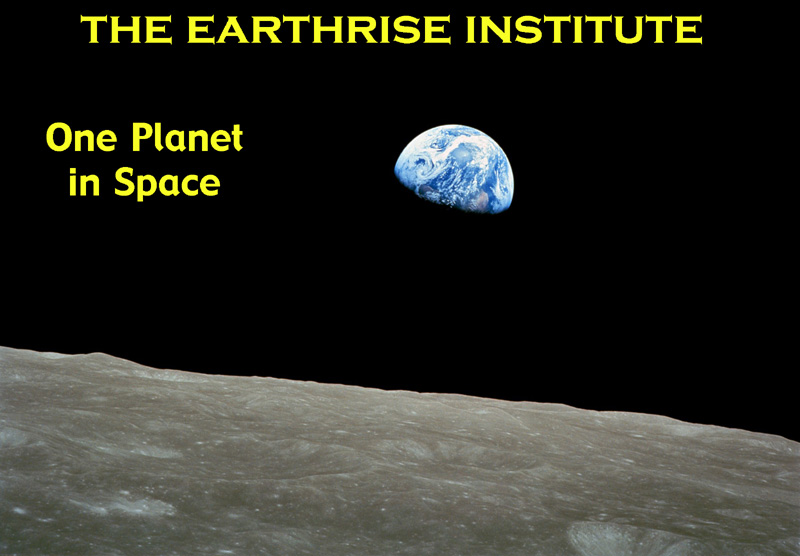
We would also like to note that this Christmas season marks the 40th anniversary of the Apollo 8 mission during which the famous Earthrise photo that has been the inspiration for the Earthrise Institute's overall mission was taken. May the hope for the future contained within this photograph continue to inspire us as we move forward into the new year and beyond.
December 19, 2008
We are very saddened to note the passing away of Majel Barrett Roddenberry (widow of Star Trek creator Eugene Roddenberry, and who played numerous roles in the various Star Trek series) on December 18. Her son, Eugene Roddenberry, Jr., has been a strong supporter of Earthrise for several years, and we extend condolences to him and to the entire Roddenberry family during this sad time.
Several years ago, Majel donated several dozen autographed photographs of herself to Earthrise so that we could utilize them for fundraising purposes, and we have been honored that she believed in the Earthrise vision and had chosen to help us in this manner. As always, all proceeds from the sale of these photographs will go to Earthrise and its programs, and perhaps in a small way help bring about the positive vision for humanity that was epitomized by Star Trek.
We are also saddened to note the passing away this past week of astronomer Steven Ostro. Steve pioneered the usage of the 300-meter Arecibo radio telescope in Puerto Rico and the tracking antennas of the Deep Space Network for obtaining radar observations of near-Earth asteroids, and much of what we know about these objects has come from his research efforts. We extend condolences to his family, friends, and colleagues.
We have posted a new update to our comet update page in our "Countdown to 500 Comets" program.
December 10, 2008
We have posted a new update to our comet update page in our "Countdown to 500 Comets" program.
One of our earlier "Countdown" comets, Comet 96P/Machholz 1, has been in the news lately, with recent reports indicating an unusual chemical composition and possibly an origin from another solar system. These reports, along with some relevant links, are now discussed in an update to this comet's original "Countdown" entry.
December 2, 2008
Comet 445 has now been added to the "Countdown to 500 Comets" program, and our comet update page has been updated accordingly. This update also reflects the fact that Comet 205P/Giacobini P/2008 R6 has unexpectedly brightened recently and is again observable.
November 29, 2008
We have posted a new update to our comet update page in our "Countdown to 500 Comets" program.
We have also updated the relevant links to the SOHO comet web site, due to a recent move that they have undergone on their end.
November 20, 2008
Comets 443 and 444 have now been added to the "Countdown to 500 Comets" program, and our comet update page has been updated accordingly.
November 9, 2008
We congratulate countdown mentors Martin McKenna of Maghera, Co. Derry, Northern Ireland and Amar Sharma of Mumbai, India, for being new recipients of our comet observing award, given to those who successfully observe ten or more comets in our "Countdown to 500 Comets" program. (We are still seeking a sponsor for this award.)
We have posted a new update to our comet update page in our "Countdown to 500 Comets" program.
October 26, 2008
Comet 442 has now been added to the "Countdown to 500 Comets" program, and our comet update page has been updated accordingly.
October 21, 2008
Earthrise President Alan Hale will be speaking at the New Mexico Space Explorers Education Days event that will be held at the New Mexico Museum of Space History in Alamogordo, New Mexico from October 22 through October 25. There will be numerous happenings and speakers throughout the four-day event; Dr. Hale will speak on each of the final three days.
October 19, 2008
We have posted a new update to our comet update page in our "Countdown to 500 Comets" program.
October 9, 2008
Comet 441 has now been added to the "Countdown to 500 Comets" program, and our comet update page has been updated accordingly.
October 6, 2008
A newly-discovered near-Earth asteroid is entering the Earth's atmosphere tonight! 2008 TC3, discovered last night by the Mt. Lemmon survey in Arizona, will apparently enter the atmosphere above northern Sudan at 2:46 UT October 7 (8:46 P.M. MDT October 6). It is a very tiny object -- no more than perhaps five meters in diameter -- and will not survive passage through the atmosphere, but should be a spectacular sight as a brilliant fireball for suitably-placed observers in southern Europe and northern Africa as it enters the atmosphere and disintegrates. Prior to atmospheric entry it should be visible from Europe, Africa, and eastern North America in moderate-sized telescopes; ephemerides can be calculated at the Minor Planet Center's Ephemeris Service.
We congratulate the team of the MESSENGER mission for their successful encounter with Mercury today.
September 30, 2008
Comets 439 and 440 have now been added to the "Countdown to 500 Comets" program, and our comet update page has been updated accordingly. This update also reflects the fact that Comet McNaught C/2008 A1 (a red print comet) is once again visible from the northern hemisphere.
September 26, 2008
The "In Our Skies" e-book available through our Earthrise Store now has columns up through the end of the third quarter of 2008. Among the columns from the past three months are: "Heavenly Fireworks" (July 4), "Storms on Jupiter" (July 18), "The Little Rocket That Could" (August 15), and "A Sky for the Birds" (September 19).
September 23, 2008
We have posted a new update to our comet update page in our "Countdown to 500 Comets" program. This update reflects the fact that Comet 29P/Schwassmann-Wachmann 1 is now undergoing a strong outburst.
September 19, 2008
Comet 438 has now been added to the "Countdown to 500 Comets" program, and our comet update page has been updated accordingly.
September 14, 2008
We have posted a new update to our comet update page in our "Countdown to 500 Comets" program. This update reflects the fact that Comet 29P/Schwassmann-Wachmann 1 is now again accessible in the morning sky, although it appears to be quiet for now.
September 7, 2008
A fairly bright new nova has appeared in the constellation Scorpius, located at 17h57m.5, -30d 43' (2000.0 coordinates), just west of the "spout" of the "teapot" of Sagittarius. It was discovered by Japanese amateur astronomers Koichi Nishiyama and Fujio Kabashima on September 2 and independently by several other observers shortly thereafter; it was reported as being as bright as 7th magnitude on September 5 but had seemingly faded to 8th magnitude by the evening of September 6.
September 5, 2008
The Earthrise Institute is pleased to announce its cooperation with the New Mexico Museum of Space History and other institutions in the area in staging the White Sands and Hale-Bopp Star Parties that will be held in Alamogordo, Cloudcroft, and White Sands National Monument, New Mexico from September 25 through 28, 2008. Earthrise Institute President Alan Hale will be speaking on Thursday evening, September 25, in Cloudcroft.
We have posted a new update to our comet update page in our "Countdown to 500 Comets" program.
We congratulate the Rosetta mission for its successful encounter with the asteroid (2867) Steins today.
August 23, 2008
We have posted a new update to our comet update page in our "Countdown to 500 Comets" program. This update reflects the fact that we have a new red print comet, Comet 6P/d'Arrest, and also the fact that Comet McNaught C/2008 A1 (currently visible only from the southern hemisphere) is now flirting with naked-eye visibility.
August 15, 2008
There is a deep partial lunar eclipse taking place this weekend, on the night of August 16-17. Mid-eclipse, during which 81% of the moon will be within the Earth's umbra, takes place at 21:10 UT (3:10 P.M. MDT) on August 16. The eclipse will be visible from all of Europe, Africa, Australia, South America, and Antarctica, and from all but the easternmost extremities of Asia. North America is almost completely left out, except for the far northeastern U.S. and northeastern Canada, which will see the last stages of the exiting penumbral eclipse shortly after moonrise.

August 14, 2008
We have posted a new update to our comet update page in our "Countdown to 500 Comets" program. This update reflects the fact that we have a new red print comet, Comet McNaught C/2008 A1 (currently visible only from the southern hemisphere).
Earthrise Institute President Alan Hale will be attending (although not speaking at) the "Passing the Torch" DC-X Reunion conference that will be held at the New Mexico Museum of Space History in Alamogordo, New Mexico on August 17-19.
August 6, 2008
Comet 437 has now been added to the "Countdown to 500 Comets" program, and our comet update page has been updated accordingly.
We congratulate Ray Maher of Port Elizabeth, New Jersey, USA for being the newest recipient of our comet observing award, given to those who successfully observe ten or more comets in our "Countdown to 500 Comets" program. (We are still seeking a sponsor for this award.)
August 1, 2008
Comet 436 has now been added to the "Countdown to 500 Comets" program, and our comet update page has been updated accordingly.
July 29, 2008
Earthrise Institute President Alan Hale's planned trip to Devon Island for the August 1 total solar eclipse has been cancelled, primarily due to weather considerations. The Mars Institute personnel who are on-site at Devon Island will continue to webcast the happenings during the eclipse; any interested venues are invited to contact the Earthrise Institute in order to facilitate the necessary arrangements.
The path of totality for the August 1 eclipse will pass over several islands in the Canadian Arctic, the northern tip of Greenland, then across part of the islands of Novaya Zemlya, then central Russia (including the city of Novosibirsk) and finally western Mongolia and northern China. The partial phases of the eclipse will be visible from most of Asia (except for the southwestern and easternmost extremities), central and eastern Europe, Iceland, Greenland, and northeastern Canada.
July 24, 2008
Earthrise Institute President Alan Hale will be traveling to Devon Island in the Canadian Arctic to observe the total solar eclipse on August 1; he will be there as a guest of the Mars Institute, and will be viewing the eclipse from their Mars simulation facility there. In addition to attempting scientific observations during the eclipse (including the possible detection of any comets near the sun at the time of totality, a project being conducted in collaboration with the SOHO project), together with the Mars Institute we are offering venues a chance to host real-time and/or delayed webcasts of the eclipse. Any potential venues who might be interested in hosting these webcasts are invited to contact the Earthrise Institute, and we will post a list of these venues on this page a few days before the eclipse.
We are also exploring the idea of hosting a log and/or photographs from Devon Island on this web site during the trip; check this page in coming days for further details.
Comet 435 has now been added to the "Countdown to 500 Comets" program, and our comet update page has been updated accordingly. Because of the trip to Devon Island there will almost certainly not be any further updates to the update page until early August.
July 15, 2008
We have posted a new update to our comet update page in our "Countdown to 500 Comets" program.
July 11, 2008
We congratulate Con Stoitsis of Melbourne, Victoria, Australia for being the newest recipient of our comet observing award, given to those who successfully observe ten or more comets in our "Countdown to 500 Comets" program. (We are still seeking a sponsor for this award.) Con is Director of the Comets section of the Astronomical Society of Victoria.
July 5, 2008
We have posted a new update to our comet update page in our "Countdown to 500 Comets" program. This update reflects the fact that Comet Christensen C/2006 W3 is now visible in the morning sky.
July 3, 2008
Since the beginning of 2008 we have been maintaining somewhat of a low profile while we have been engaging in some refocusing efforts that will allow us to be a more responsive space-oriented research and educational organization. We are now about ready to start announcing some of the efforts that we have been developing during this time, and will be doing so through this page over the coming few weeks.
At this time we are formally deactivating most of the links to the fundraising campaign we initiated in late 2006 in conjunction with a matching grant commitment made to us at that time by private space explorer Anousheh Ansari. (We will maintain links to the page for this campaign from a handful of pages that discuss it in historical terms.) Within the near future we will be initiating a new fundraising campaign, and will announce it here at the appropriate time (and we will include a direct link from our home page). All contributions made to Earthrise after July 1, 2008 will be included towards this new campaign.
By request, any organizations (and individuals) that make contributions to Earthrise at the "Earthrise Associate" or "Earthrise Contributor" level (see our donor page for an explanation of these levels) may now have a link to their organization's (or personal) web site as a part of their listing on our Contributor's page.
We have posted a new update to our comet update page in our "Countdown to 500 Comets" program. This update reflects the fact that Comet Boattini C/2007 W1 is again visible from the northern hemisphere and is bright enough to be easily visible in binoculars, and perhaps even dimly visible to the unaided eye under good sky conditions.
In recognition of the fact that "Countdown to 500 Comets" is an educational program, we are making a slight change to the update page format beginning with this update. We will highlight with red print any comets that are 9th magnitude or brighter (and that are also easily accessible for observation) at the time of the update in question; these comets should be detectable from suburban areas with small telescopes, and thus are those that are specifically recommended for "Countdown" participating students.
We wish a Happy Fourth of July celebration to our participants and friends here in the U.S.
June 28, 2008
The "In Our Skies" e-book available through our Earthrise Store now has columns up through the end of the second quarter of 2008. Among the columns from the past three months are: "Away, Across the Universe" (April 4), "A Meeting of Worlds" (May 2), "Phoenix Arrives!" (May 30), and "Tunguska Centennial" (June 27).
June 25, 2008
We have posted a new update to our comet update page in our "Countdown to 500 Comets" program.
June 15, 2008
We have posted a new update to our comet update page in our "Countdown to 500 Comets" program.
June 4, 2008
Comet 434 has now been added to the "Countdown to 500 Comets" program, and our comet update page has been updated accordingly.
We are pleased to welcome Giuseppe Pappa of Mascalucia, Sicily, Italy as a new Mentor for "Countdown to 500 Comets." In addition to being an active comet observer Giuseppe has (so far) successfully discovered at least two comets with the LASCO coronagraphs aboard SOHO.
June 2, 2008
For the past few months we have been quietly working on some refocusing efforts here at Earthrise, and there are several exciting projects that may be coming to fruition within the not-too-distant future. We are tentatively planning some announcements to this effect around July 1; stay tuned!
Comet 433 has now been added to the "Countdown to 500 Comets" program, and our comet update page has been updated accordingly. This update also reflects the fact that the current naked-eye Comet Boattini C/2007 W1 is now visible only from the southern hemisphere, and that Comet Broughton C/2006 OF2 has now reappeared in the morning sky.
We congratulate the team of the Phoenix Mars Lander mission for their successful landing on the Martian surface this past May 25, and we look forward to exciting results from Phoenix during the coming weeks and months.
May 25, 2008
We are saddened to note the passing away of the mother of Earthrise team member Wynne Lienhardt during this past week. Wynne has been both a strong financial supporter and a strong moral supporter of Earthrise for several years, and we extend our condolences to her and her family during this sad time.
We have posted a new update to our comet update page in our "Countdown to 500 Comets" program. This update reflects the current naked-eye visibility of Comet Boattini C/2007 W1 as well as Comet 15P/Finlay, currently visible from the southern hemisphere and which should hopefully be added to "Countdown" by sometime in July.
We wish "good luck!" to the team of the Phoenix Mars Lander mission in their attempt for a successful landing upon the surface of Mars later today, and we hopefully look forward to exciting results from Phoenix during the coming weeks and months.
May 14, 2008
Earthrise President Alan Hale will be speaking at the National Atomic Museum in Albuquerque, New Mexico this coming Saturday afternoon (May 17) at 5:30 P.M. (MDT). Copies of his book Everybody's Comet will be for sale.
Recent calculations have shown that the orbits for "Countdown" comets 430 and 431 (both recently-discovered objects) are somewhat different from those originally calculated, and we have updated their tally page entries accordingly.
May 10, 2008
Comets 431 and 432 have now been added to the "Countdown to 500 Comets" program, and our comet update page has been updated accordingly. Comet 432 was discovered by "Countdown" mentor Quanzhi Ye last July, and may become bright enough for naked-eye visibility in early 2009; we are delighted to add this comet to the program.
May 4, 2008
Comet 430 has now been added to the "Countdown to 500 Comets" program, and our comet update page has been updated accordingly.
We have now begun a "What's New" archive page for the 2008 entries.
April 25, 2008
We have posted a new update to our comet update page in our "Countdown to 500 Comets" program.
A fairly bright new nova has appeared in the constellation Sagittarius, located at 18h06m.0, -27d 14' (2000.0 coordinates), slightly north of the "spout" of the "teapot." When discovered by Japanese amateur astronomers Koichi Nishiyama and Fujio Kabashima on April 18 it was about magnitude 8 1/2, but according to the most recent reports it is now near magnitude 6 1/2 and thus is near naked-eye visibility.
April 13, 2008
We have posted a new update to our comet update page in our "Countdown to 500 Comets" program.
When we suffered our computer system crash last September we lost the capability of obtaining astronomical images with our telescope and imaging system. Because of problems we encountered in getting the correct software loaded and operational, and also because we have been concentrating on other issues, we have not been able to obtain any images since then. We are now happy to announce that our imaging system is now up and operational again, and on the night of April 11-12 we obtained images of Comet Boattini C/2007 W1; we have posted one of these in our image gallery. We hope to be utilizing our imaging system much more extensively during the months to come.
April 6, 2008
Comet 429 has now been added to the "Countdown to 500 Comets" program, and our comet update page has been updated accordingly.
March 29, 2008
We have posted a new update to our comet update page in our "Countdown to 500 Comets" program.
The "In Our Skies" e-book available through our Earthrise Store now has columns up through the end of the first quarter of 2008. Among the columns from the past three months are: "Encounter at Mercury" (January 11), "Half-Century of American Space" (February 1), "Reflections at a Half-Century" (March 7), and "Visionary Extraordinaire" (March 28).
Two bright supernovae are currently visible in skies. Supernova 2008ax in the "Cocoon Galaxy" NGC 4490 was discovered by the Lick Observatory Supernova Search on March 3, and initially bore some resemblance to Supernova 1987A that appeared in the Large Magellanic Cloud two decades ago; it is currently slightly brighter than 14th magnitude. Supernova 2008bk in the galaxy NGC 7793 was discovered by amateur astronomer Berto Monard in Pretoria, South Africa on March 25, and was initially reported as being as bright as magnitude 12 1/2. This object is currently visible only from the southern hemisphere.
March 20, 2008
Comet 428 has now been added to the "Countdown to 500 Comets" program, and our comet update page has been updated accordingly.
New images of Comet Hale-Bopp taken in October 2007 have now been released, as part of a recent research paper authored by three Hungarian astronomers. They have graciously allowed us to post one of these images on our Hale-Bopp images page.
We mourn the passing of science writer, science fiction author, and space visionary Arthur C. Clarke on March 19, 2008 in Sri Lanka at the age of 90. He has undoubtedly inspired several generations of us to pursue careers in science and space, and of course is responsible for the original concept of placing communications satellites in geosynchronous orbit -- an idea he first published in 1945, twelve years before the first artificial satellites were launched. We at Earthrise are privileged to have worked with Clarke in several projects, including the supplying of a telescope to the Arthur C. Clarke Institute several years ago. Earthrise founder Alan Hale specifically thanks Clarke for personally allowing permission for use of the title of one of his short story collections ("The Other Side of the Sky") as the name for the radio program he hosted between 2004 and 2006.
We wish a Happy Norouz (Persian New Year) to all of our Iranian friends and colleagues, and a Happy Easter to all those around the world who celebrate this holiday.
March 8, 2008
We have posted a new update to our comet update page in our "Countdown to 500 Comets" program. This update reflects the fact that Comet McNaught C/2006 Q1 is once again visible from the northern hemisphere.
February 27, 2008
We have posted a new update to our comet update page in our "Countdown to 500 Comets" program. This update reflects the fact that Comet McNaught C/2007 T1 is once again visible from the northern hemisphere.
February 19, 2008
There is a total eclipse of the moon coming up during mid-week; it will be visible during the evening hours on Wednesday night, February 20, as seen from North and South America, and during the morning hours on Thursday, February 21, as seen from Europe, Africa, and western Asia. Totality is moderately short, with a duration of 50 minutes.
February 16, 2008
Two near-Earth asteroids are making moderately close approaches to Earth during the next few days, both of which are near 12th magnitude, i.e., bright enough to view with moderately-sized telescopes. (4450) Pan will pass 0.041 AU (6.1 million km, or 3.8 million miles) from Earth on Tuesday, February 19; it is currently in Monoceros and is traveling rapidly southwestward towards Lepus (south of Orion) and Eridanus, and will rapidly fade from view after mid-week. (153591) 2001 SN263 will pass 0.066 AU (9.9 million km,or 6.1 million miles) from Earth on Wednesday, February 20; it is currently in Gemini, and is traveling southeastward towards Hydra and should remain visible (although fading) for another few weeks. Recent radar bounce observations obtained with the 300-meter Arecibo radio telescope in Puerto Rico have shown that this object is actually a triple system. Ephemerides for both asteroids can be calculated via the Minor Planet Center's ephemeris service.
February 13, 2008
We have posted a new update to our comet update page in our "Countdown to 500 Comets" program. This update reflects the fact that Comet McNaught C/2005 L3 is now visible in the morning sky.
February 11, 2008
We have posted a new update to our comet update page in our "Countdown to 500 Comets" program. This update includes the apparent "asteroid" 2005 WY3, which may possibly be a weakly active comet.
February 9, 2008
Comet 427 has now been added to the "Countdown to 500 Comets" program, and our comet update page has been updated accordingly. This comet has the potential of becoming dimly visible to the unaided eye in three to four months.
February 6, 2008
Comet 426 has now been added to the "Countdown to 500 Comets" program, and our comet update page has been updated accordingly.
It has come to our attention that the Comet Observation Home Page (one of our primary reference links in "Countdown to 500 Comets") has, for the time being, become inactive. Until it has returned -- hopefully soon -- we have retained its mention on the various "Countdown" pages but have deactivated the links.
An annular solar eclipse will be taking place tomorrow, February 7, 2008. The path of annularity crosses the extreme southern Pacific Ocean and parts of Antarctica; the partial phases of the eclipse will be visible from New Zealand, southeastern Australia, and some of the South Pacific islands.
February 1, 2008
We have posted a new update to our comet update page in our "Countdown to 500 Comets" program.
We congratulate Earthrise Team member Mike Begbie for his recent relocation to Hove, Brighton, U.K. Mike has also joined our list of Mentors for "Countdown to 500 Comets."
January 28, 2008
A recently-discovered near-Earth asteroid, 2007 TU24, is currently making a very close approach to Earth. The closest approach itself will occur at 2:38 A.M. MST on January 29, at a distance of 0.0037 AU (554,000 km, or 344,000 miles -- 1.4 times the moon's distance from Earth). During the next couple of nights 2007 TU24 will be traveling through the northern sky and should be as bright as 11th magnitude. Ephemerides can be calculated via the Minor Planet Center's ephemeris service.
January 19, 2008
Comet 425 has now been added to the "Countdown to 500 Comets" program, and our comet update page has been updated accordingly.
January 17, 2008
January 15 was the Grand Opening of an Astronomy-themed Teacher Resource Center (TRC) in Socorro, New Mexico. The TRC has several telescopes and astronomy equipment along with many astronomy curriculum materials. The TRC is available to educators in Socorro and throughout the surrounding area, and any who are interested may contact Earthrise Educator Judy Stanley.
We have added images of several of the recently-added "Countdown" comets on a new page in our Comet Image Gallery, along with some new images of Comets 17P/Holmes and 8P/Tuttle.
January 15, 2008
The Earthrise Institute is pleased to announce and welcome our initial Board of Advisors. We are honored to have such distinguished individuals who are willing to be a part of the Earthrise effort and to help us bring about the Earthrise vision, and we look forward to working with them to make this happen.
Comet 424 has now been added to the "Countdown to 500 Comets" program, and our comet update page has been updated accordingly.
The "In Our Skies" e-book available through our Earthrise Store now has columns up through the end of 2007. Among the columns from the past three months are: "Half-Century of Space" (October 5), "A Comet for the Ages" (November 2), "Finding the Next Earth" (November 23), and "Ghosts of Christmas Moons" (December 21).
January 3, 2008
We hope that all of our Earthrise participants and readers had a happy New Year's celebration for 2008. We anticipate many exciting developments during this coming year, and invite everyone to stay tuned as these take shape. We expect to be making several additional updates to this web site over the next few days.
Comet 423 has now been added to the "Countdown to 500 Comets" program, and our comet update page has been updated accordingly.
The annual Quadrantid meteor shower is expected to peak tomorrow morning, January 4. The maximum, which is usually very brief, is expected around 6:40 Universal Time (11:40 P.M. January 3 MST), which means the prime viewing locations will be in eastern North America. The peak rates could exceed 100 meteors per hour.
Back to main page